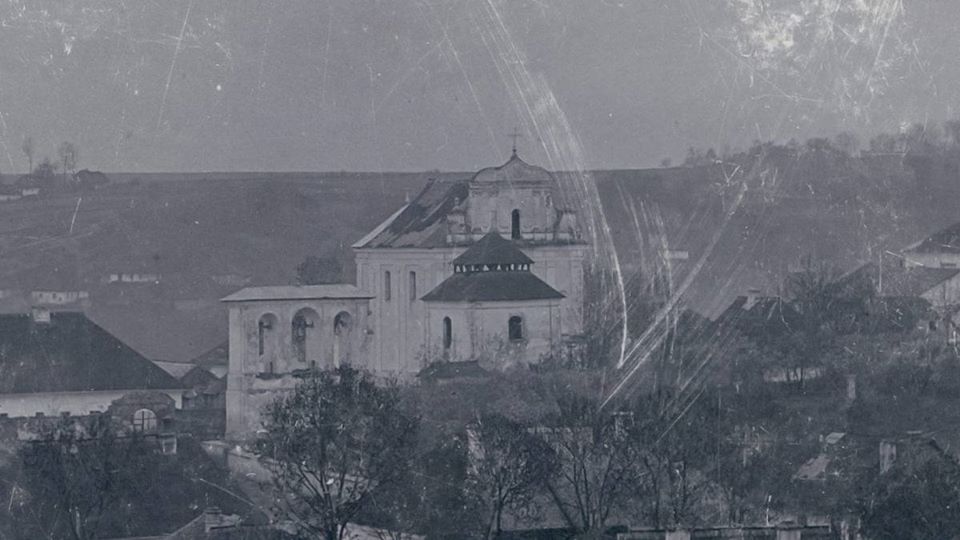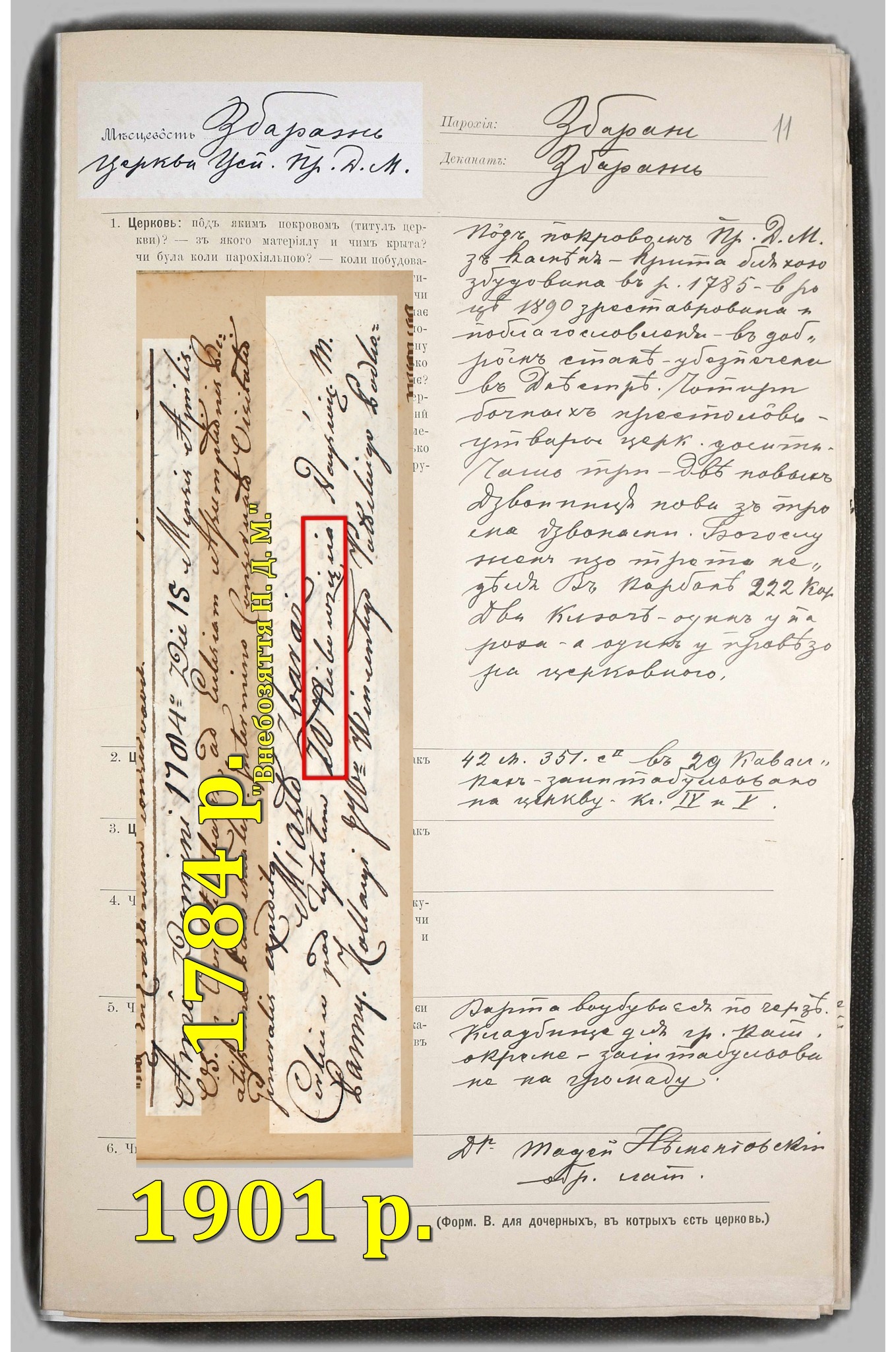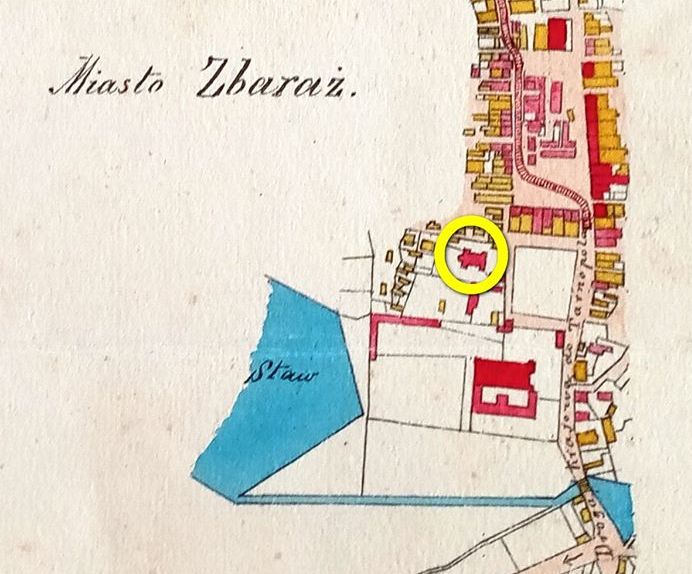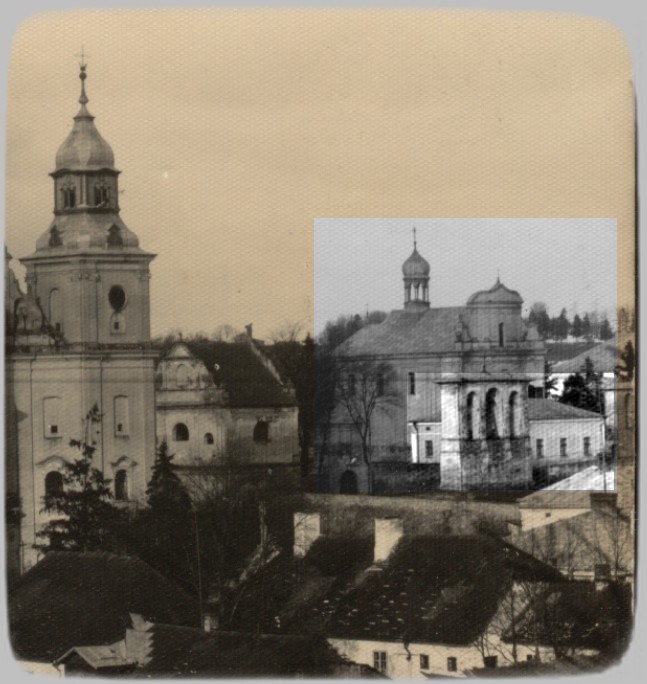
The first written mention of the church under the name “cerkwa Ouspenia Naświętszej Matki Bożej zbaraskiej” dates back to August 13–15, 1700, when Father Daniil Korytynsky, visitor of churches and monasteries of the Zbarazh vicariate, according to the decree of heir Count Józef Potocki, “transferred” all churches and monasteries of the Zbarazh vicariate to the Union. The text refers to this church as “built of masonry in the shape of a cross; after a fire, it is entirely cracked and requires urgent repair, but it has a new, good roof.”
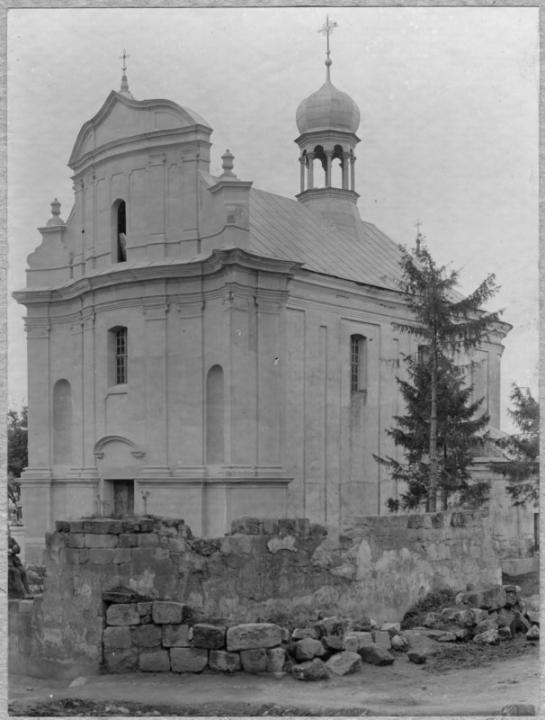
The architectural resemblance of the present Assumption Church to the Trinitarian Church of Kamianets led to the hypothesis that this monastic order was founded in Zbarazh during the reign of the then-owner Józef Potocki (†1751). Spiritual Sanctuaries of the Zbarazh Region (O. Mandryk) notes that “on the site of the old church, around 1755, a new single-nave stone church in Baroque style was built, which in form resembles a church.”
Information regarding Trinitarians in Zbarazh is highly contradictory and not confirmed by historical sources. Polish researcher Mirosława Sobczyńska-Szczepańska, in her monograph Architektura trynitarzy na ziemiach dawnej Rzeczpospolitej (2017), describes all known Trinitarian churches in the region. Concerning Zbarazh, she writes: “Information about Trinitarian establishments in Zbarazh and Bracław finds no confirmation in sources. The mention of a convent in Zbarazh first appears in Żychliński 1892, p. 35… The founder of the convent was said to be Józef Potocki, voivode of Kyiv.” T. Żychliński, in his Golden Book of Polish Nobility (Poznań, 1892), while writing the biography of Józef Potocki in Stanisławów, Nemyriv, and the Zbarazh principality, notes: “He was distinguished by great piety, allocating significant funds to the construction of his own monasteries and churches—the Jesuit Collegium in Stanisławów, the Bernardine convent in Józefów… He rebuilt the church destroyed by the Turks for the same Fathers (Bernardines) in Zbarazh. He also built the Trinitarian monastery in Krotoszyn, Greater Poland… He died on May 7 in Zalozhtsy, and his funeral took place in Stanisławów (Kuryer Polski, 1751).”
Thus, the primary source (T. Żychliński) does not confirm the existence of Trinitarians in Zbarazh, attributing Potocki only with the construction of a monastery, not a church. Doubts regarding this information are reinforced by his statement that “the same Fathers (Bernardines) rebuilt the church destroyed by the Turks in Zbarazh.” The masonry church destroyed by Pasha Ibrahim Shishman was rebuilt not by Józef, but by his son Stanisław. Stylistically and historically, this masonry church belongs to the last two decades of the 17th century, and its likely founder was King Jan III Sobieski, who would have granted the city Magdeburg rights and settled the Trinitarians there.
Regarding the architectural authorship of the church, Polish researcher Dr. Jerzy Kowalczyk notes the “dynamic direction in Volyn architecture, particularly the small Assumption Church in Zbarazh, 1755,” dating it “according to an inscription on a photo from the Jagiellonian University Institute of Arts in Krakow,” implying these data may not be results of his own research. “The facade pediment directly references Borromini’s work—the facade of the Oratorium Filipinów in Rome. In turn, the wavy facade was clearly influenced by another work of this great master—S. Carlo at Quattro Fontane.” The real name of Francesco Borromini was Francesco Castelli (1599–1667), as was the name of Matteo Castelli (c. 1555–1632), who adapted a project for the Zbarazh castle—possibly relatives. The architectural style, featuring dynamic facades and light-shadow effects, could only be afforded by wealthy city owners or patrons, such as King Jan III Sobieski or his niece Teofila-Ludwika Wisniowiecka of the Zasław family.
On June 9, 1901, Zbarazh dean Father Oleksiy Zayachkivsky recorded in the church inventory: “Built in 1758, blessed after restoration in 1890—good condition. Stone construction, covered with sheet metal. Four side altars. New bell tower with three bells. Services every third Sunday. Resident assistant. House for the assistant and woodshed secured in the ‘Dniester,’ in poor condition. Number of parishioners: 898.”
In the 1930s, under Father V. Bolinovsky, according to O. Mandryk, “the church was restored: electric lighting installed, the area around the church enclosed with a stone wall and iron fence, parish house restored. In 1995, a memorial plaque was installed on the facade indicating that from 1926–1929, the ‘Prosvita’ reading room was housed in this building. In 1963, the church was closed and used as a storage facility; the iconostasis was damaged and the dome removed. The church remained in this state until 1979. In 1982, a district local history museum was established in the Assumption Church, relocated in 1989 to the Castle Palace. In 1990, the church was restored and consecrated on August 26, 1990, by Father R. Slyvka (senior). Currently, the church is part of the Orthodox Church of Ukraine (OCU), with services conducted by Father Roman Slyvka (junior).